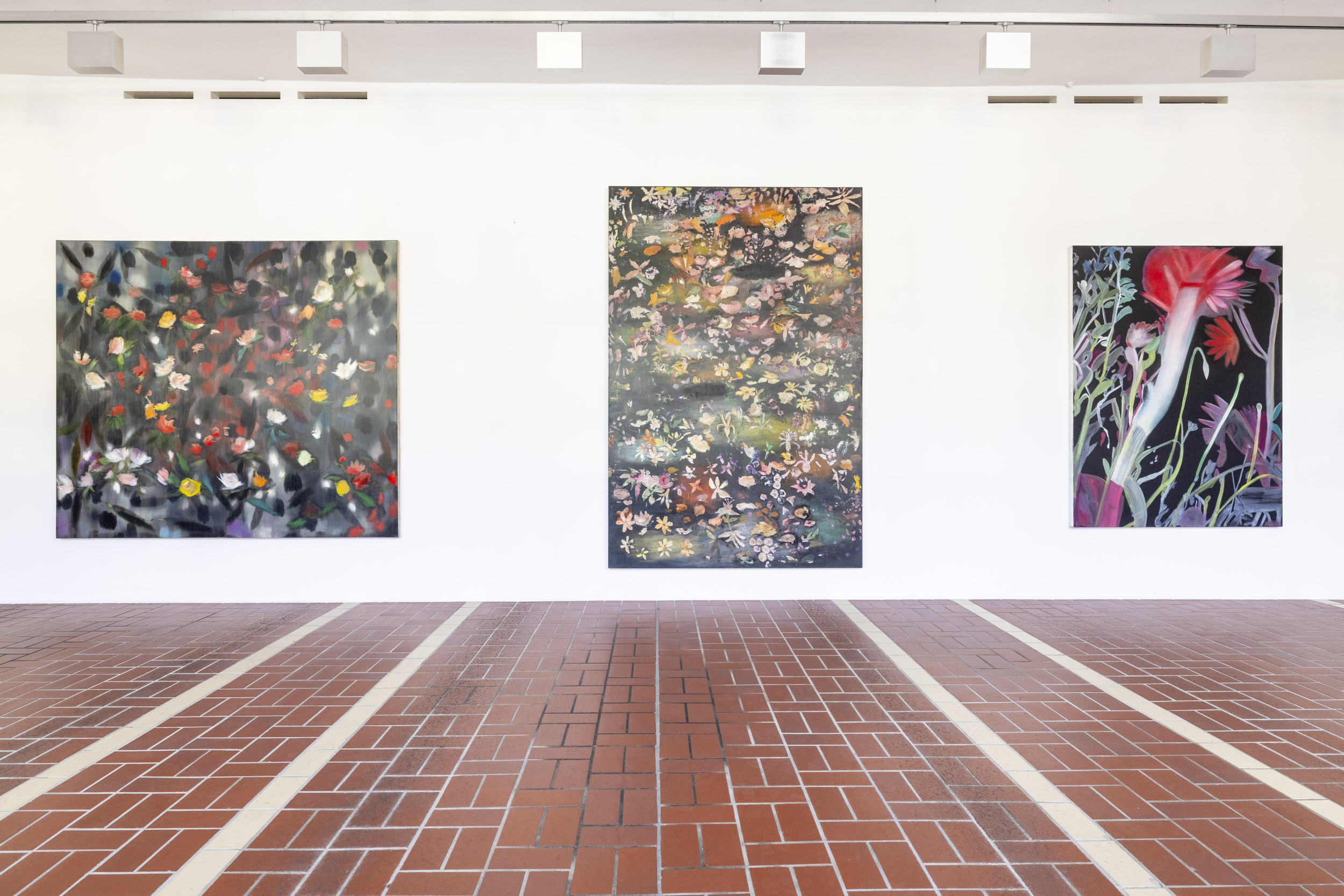
The „wonderful transformation“ of caterpillars fascinated the naturalist and artist Maria Sybilla Merian in the 17th century. Pia Fries‘ work *schwarze blumen* takes up the theme of metamorphosis.
„I’m interested in themes such as authenticity, identity, ownership … What do we own?“ This is the question Sherrie Levine posed in 1979 at the start of her artistic career, shortly after her first solo exhibition in New York. At the time, she was part of the loose-knit group known as the Pictures Generation – young artists who, in the face of the growing flood of mass media, questioned concepts such as the original and imitation or the replica.
„Sherrie Levine is an exceptionally original artist. Her works are not plagiarisms, but original creations,“ says curator Kay Heymer in the catalogue for the exhibition „After All“ (Neues Museum, Nuremberg).
Over the course of her artistic career, which now spans some 45 years, Levine has increasingly distanced herself from art theories and trends. She developed her own artistic language, which does not shy away from the morbid and grotesque - and expresses the artist's affinity for slapstick and humour.
The blurring of boundaries, where „neither death nor crime exist“ (Levine’s own words), is also evident in the sculptures of animal skeletons and skulls, for which Sherrie Levine uses fine materials such as glass or polished bronze. „False God“, for example, is a replica of a quirk of nature: a calf with two heads. The eerie, the very thing we fear, is given a new interpretation through the lustre of the material and the perfection of the craftsmanship. The original subject is alienated; nature becomes a work of art.
The territory of slapstick
Sherrie Levine about her work
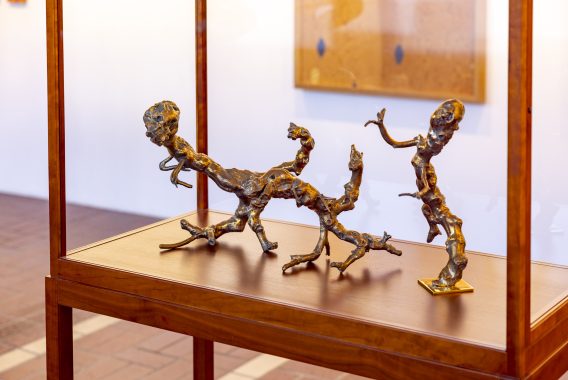
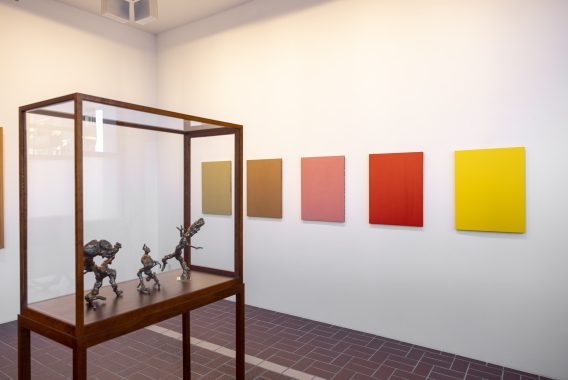
“I like the realm of slapstick, where, amidst general laughter, neither death nor crime exists.„ Sherrie Levine on the group “The Three Furies’ (below).
I don’t think it’s useful to view culture as monolithic; I’d rather see it as comprising many voices, some conscious and some unconscious. These may be at odds with one another. If we are attentive to these voices, we can collaborate with them to create something almost new. Sherrie Levine 1997, quoted in „Mayhem“, catalogue for the exhibition of the same name at the Whitney Museum of American Art, New York.
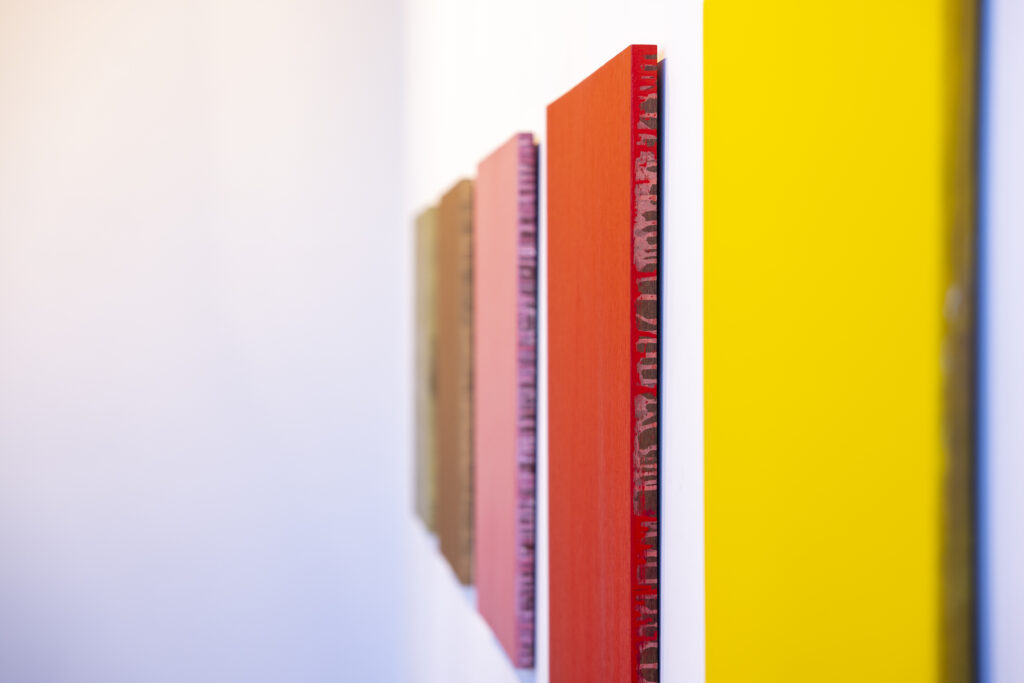
I love monochrome paintings. I think monochrome paintings represent the pinnacle of modernist painting. Sherrie Levine on works such as the series „After Yves Klein“ exhibited at KiS.
She provokes answers, she doesn't give them
At the vernissage, Florian Waldvogel gave an insight into the work of Sherrie Levine
Florian Waldvogel, head of the Modern Collection at the Tyrolean State Museum, has long been involved with the American artist and has also curated exhibitions by Sherrie Levine.
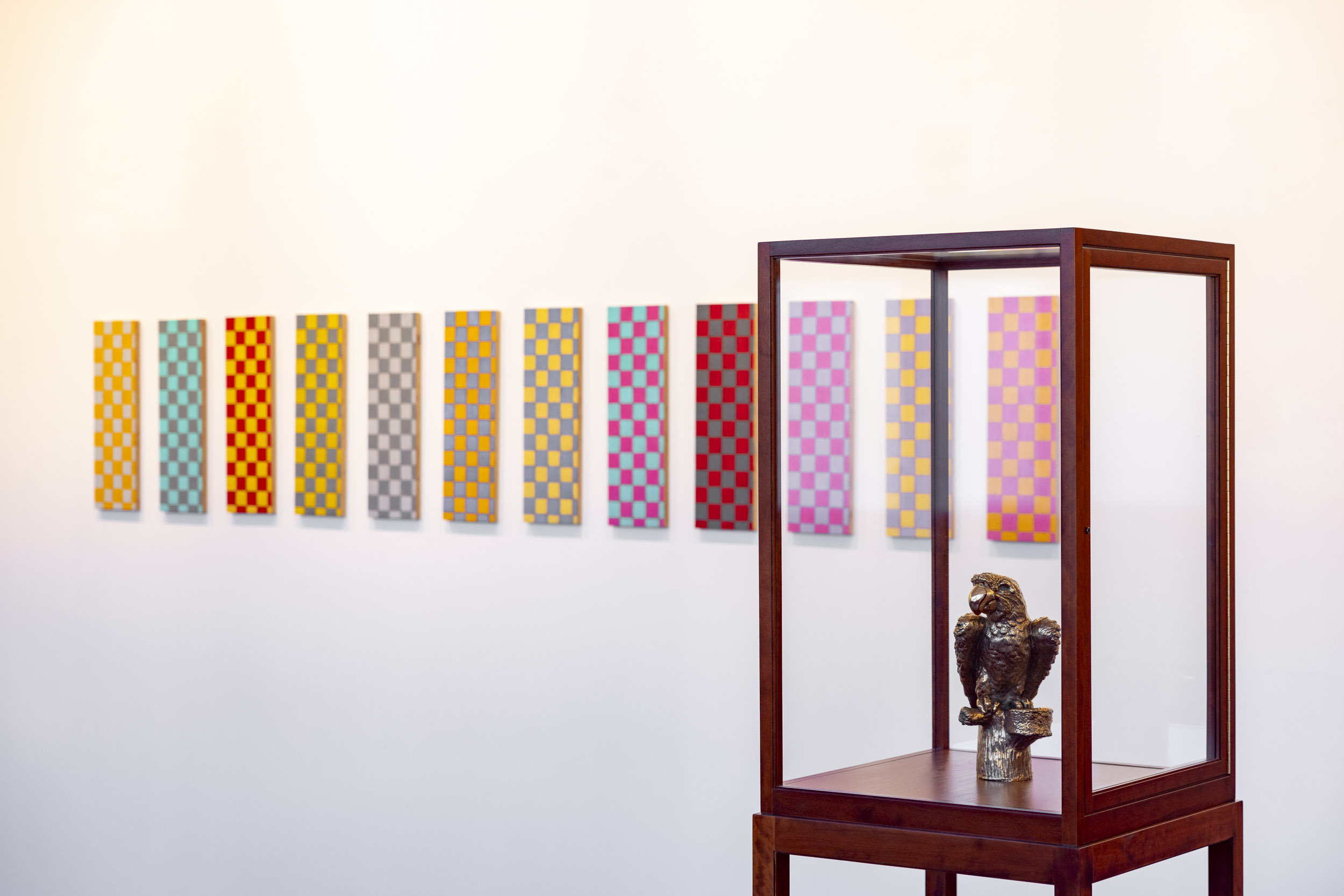
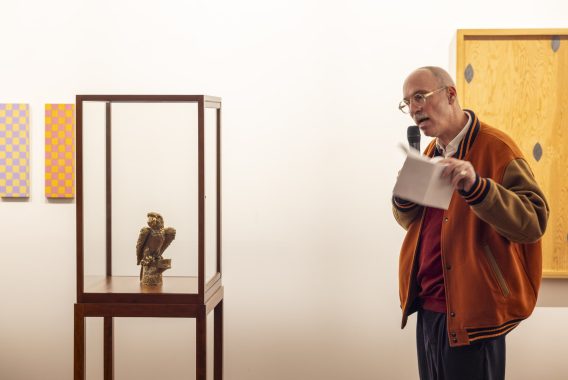
„We’re standing in the artist’s studio,“ he remarked, referring to the room in which Levine’s „Pyramid of Skulls“ is on display – her photo series based on a motif by Paul Cézanne, which the French painter used as a model for many of his works. „Why a parrot?“ Waldvogel then asked whilst examining the bronze sculpture „Loulou“ (see photo below). Because it’s an intelligent bird? Yes, but above all because Levine is referring to Gustave Flaubert’s short story „The Simple Heart“, in which this parrot plays a central role.
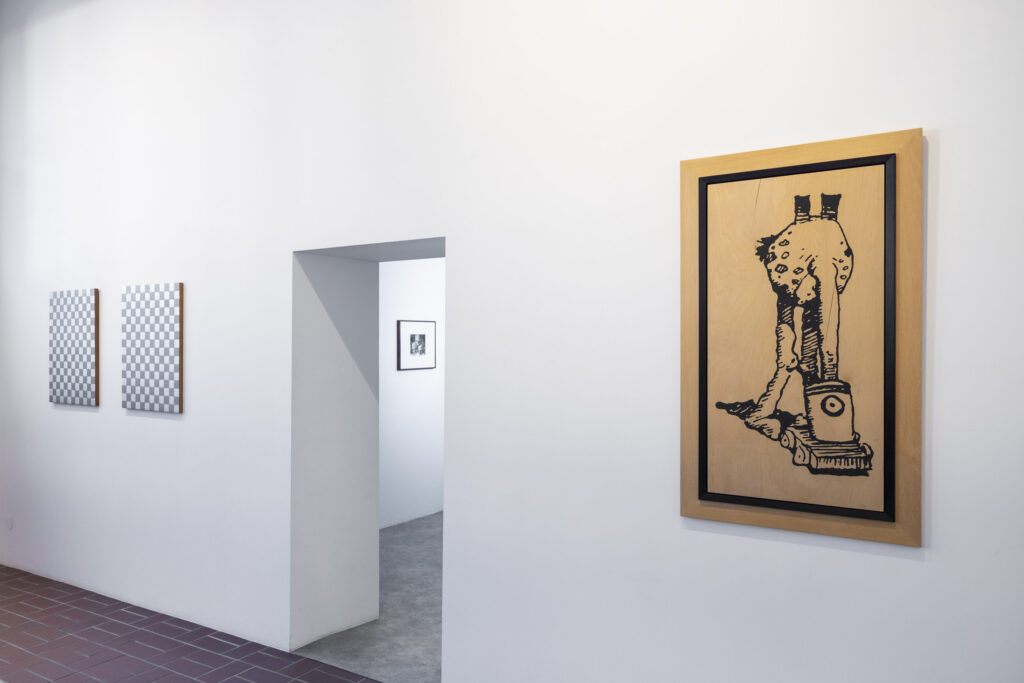
Sherrie Levine „pays homage to the classical masters in her works“, Waldvogel continues. But „at the same time, she appropriates these men“. In her works, Levine refers exclusively to originals by male artists. This is also the case in her monochrome paintings „After Yves Klein“ (see below). „It’s always about the great masters of art history“, to whom Levine responds „with a wink“ in her works. This is also evident in her chequerboard paintings, which reflect Marcel Duchamp’s fascination with the game and the pattern. With her „constant historical references“, Levine creates works that provoke answers but do not provide them, concludes Florian Waldvogel.
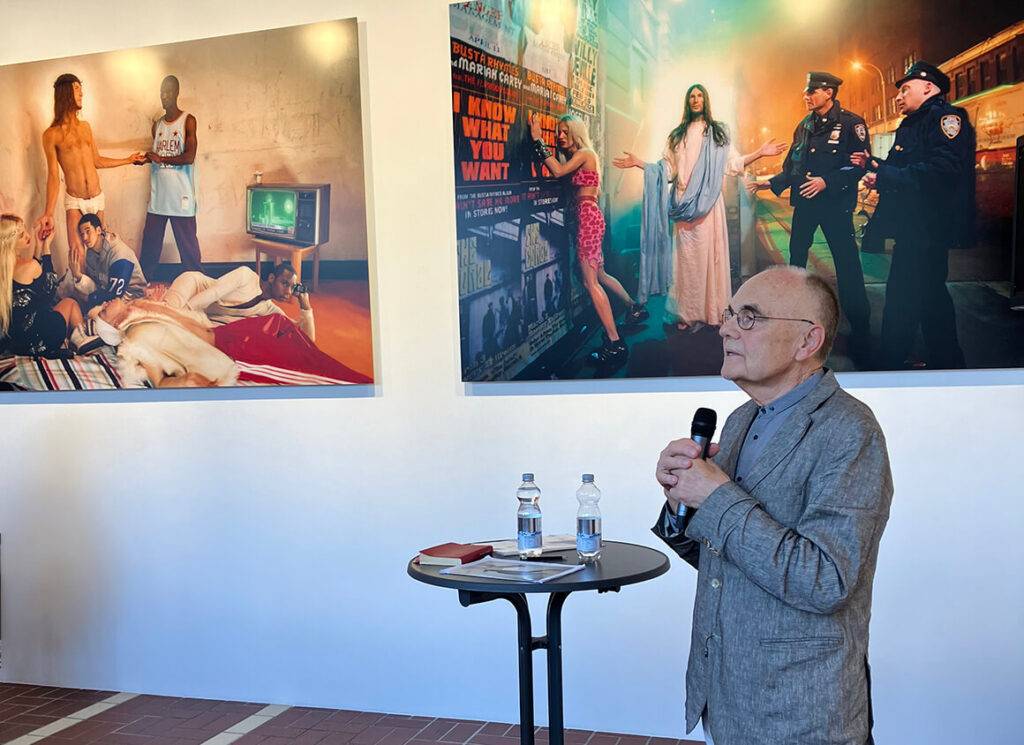
David LaChapelle is an artist I didn't know until Rafael Jablonka asked me to open this exhibition. After studying him and this work, I have to say: for me, he is one of the great, one of the greatest artists of our time.
He was socialised as a Catholic, like so many artists, for example Andy Warhol. Later, many, including LaChapelle, turned away from religion. What has remained, however, is the longing to produce images that is inherent to Catholicism. This is exactly what David LaChapelle does; it seems as if he wanted to create the Bible itself with this cycle.
You can bring a bunch of morals with the Christian thought or simply a voice at the right moment that says „you can't do that“. That stops the policemen in the picture ‚Intervention‘ from doing what they are doing.
LaChapelle does not make Catholic propaganda, but shows people who set themselves free. They do it because they can. That's why, for me, these pictures are among the most magnificent of this genre.
Sherrie Levine
„After Walker Evans“ made her famous
Sherrie Levine was born in Hazleton, Pennsylvania, in 1947 and grew up in St Louis, Missouri. She studied painting and printmaking at the University of Wisconsin and, whilst at university, also explored photography, papermaking, bookbinding, letterpress printing and other disciplines. After moving to New York City, she held her first solo exhibition there in 1977. In 1981, she made her breakthrough with her works „After Walker Evans“, an American photographer who documented poverty in the southern states of the USA in the 1930s.
Sherrie Levine became known to a wide audience in Europe in 1991 when her works were presented in museums in Zurich, Paris, Münster and Malmö as part of an exhibition tour. Since then, numerous gallery presentations and exhibitions have followed, including at Rafael Jablonka's Böhm Chapel in Hürth.
In 2011, the Whitney Museum in New York dedicated a major solo exhibition to her, entitled „Mayhem“, followed in 2016/17 by „After All“, a major solo exhibition at the Neues Museum in Nuremberg.