„This very light, weightlessness ...“
Interview with Michael Ziegler
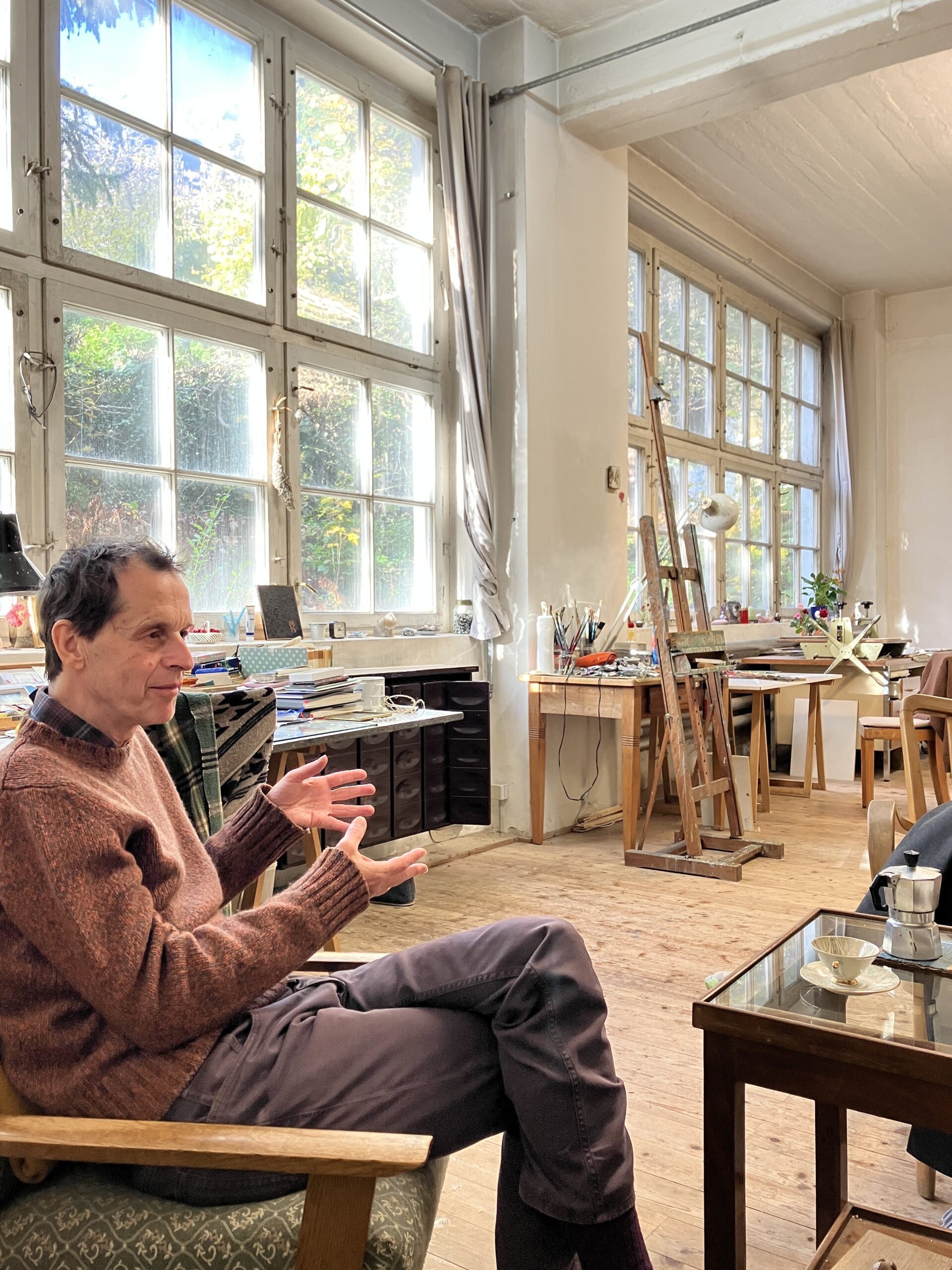
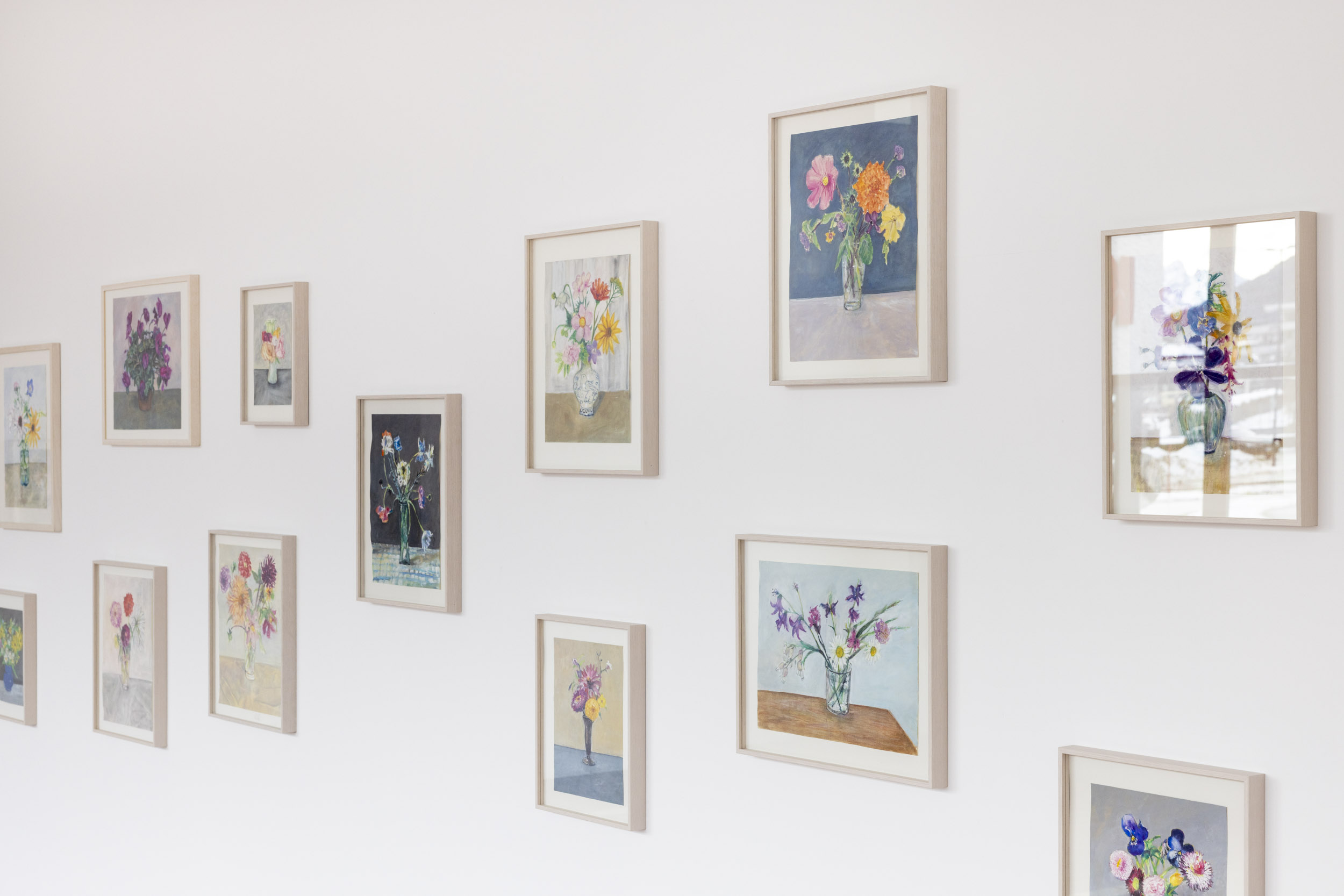
Michael Ziegler is a draughtsman, painter and photographer. From 12 December 2025 to 15 March 2026, he will be exhibiting a series of flower paintings and a selection of other still lifes under the title „Still Life“. In November 2025, Michael Ziegler (MZ) spoke to Esther Pirchner, Sylvia Frenes-Lutz and Angela Braster (KiS) about his pictorial motifs, artistic techniques and series of works, which are often continued over a long period of time.
KiS: You have always worked with different media and techniques. Do you choose these for the motifs of your pictures or certain series of works?
MZ: I have in mind that a work is something like a house: with different floors, different rooms and different views. That's why there are initially three media - photography, painting and drawing - and all kinds of subgroups within them. In photography, for example, there are those that accompany me through the day like a haiku, and analogue photos, such as double exposures. A third group is film stills. As a passionate film viewer, I have an extensive film collection. When I watch a film, I make notes about what corresponds to my work. Then the film is stopped and the image is photographed.
The most important and numerically largest group is drawing. It is the basis for many things, even for many photographs. For painting, it's the be-all and end-all. When I have an idea, I sketch it out. It's quick, uncomplicated and easy. You can also change ideas again and make pans. The next step is usually watercolour sheets, and now and again - if I feel I want to take it further - I paint an oil painting on canvas or in a very small format on paper. With the landscapes, I used to have the feeling that they needed a certain format - 1.50 or 1.60 metres - but I now do that less often.
In addition to the different media, there is also a wide stylistic range. These include „realistic“ paintings such as the still lifes, the flower paintings and the very important group of landscapes. They are not created one after the other, but often with long pauses in between.
Then it also goes over into the abstract. A very important series is „from you to me“, in which I deal with the art of the Far East. Similar to Goethe's „West-Eastern Divan“, I expand my treasure trove of forms by taking inspiration from Indian, Chinese and Japanese sculpture and painting. In this group of works, which I began almost thirty years ago, there are many playful, open, almost abstract works.
Behind all of this is the idea of different perspectives. The development doesn't just go in one direction, it's elliptical. I pick up groups again that I left behind ten or twenty years ago, and it is important to me to also organise exhibitions with older works. I'm always looking to see how different groups intertwine anew or inspire me to do something new.
KiS: You say that the drawing is rather quick and fleeting. How long do you work on such pictures?
MZ: It can take over a year from the initial idea to the finished picture - even in the case of a drawing. The drawings I exhibit are often a drawing of a drawing of a drawing. At first I tend to scribble on the page, and when it reaches a certain density, I make another drawing of it. Sometimes things change: men become women, the drawing is turned upside down or something is erased. The result, sometimes the tenth sheet I produce, is often very delicate and restrained. I destroy most of the ones in between.
KiS: How do you choose your motifs? Why do certain landscapes, flowers or reclining figures inspire you to capture them in a picture?
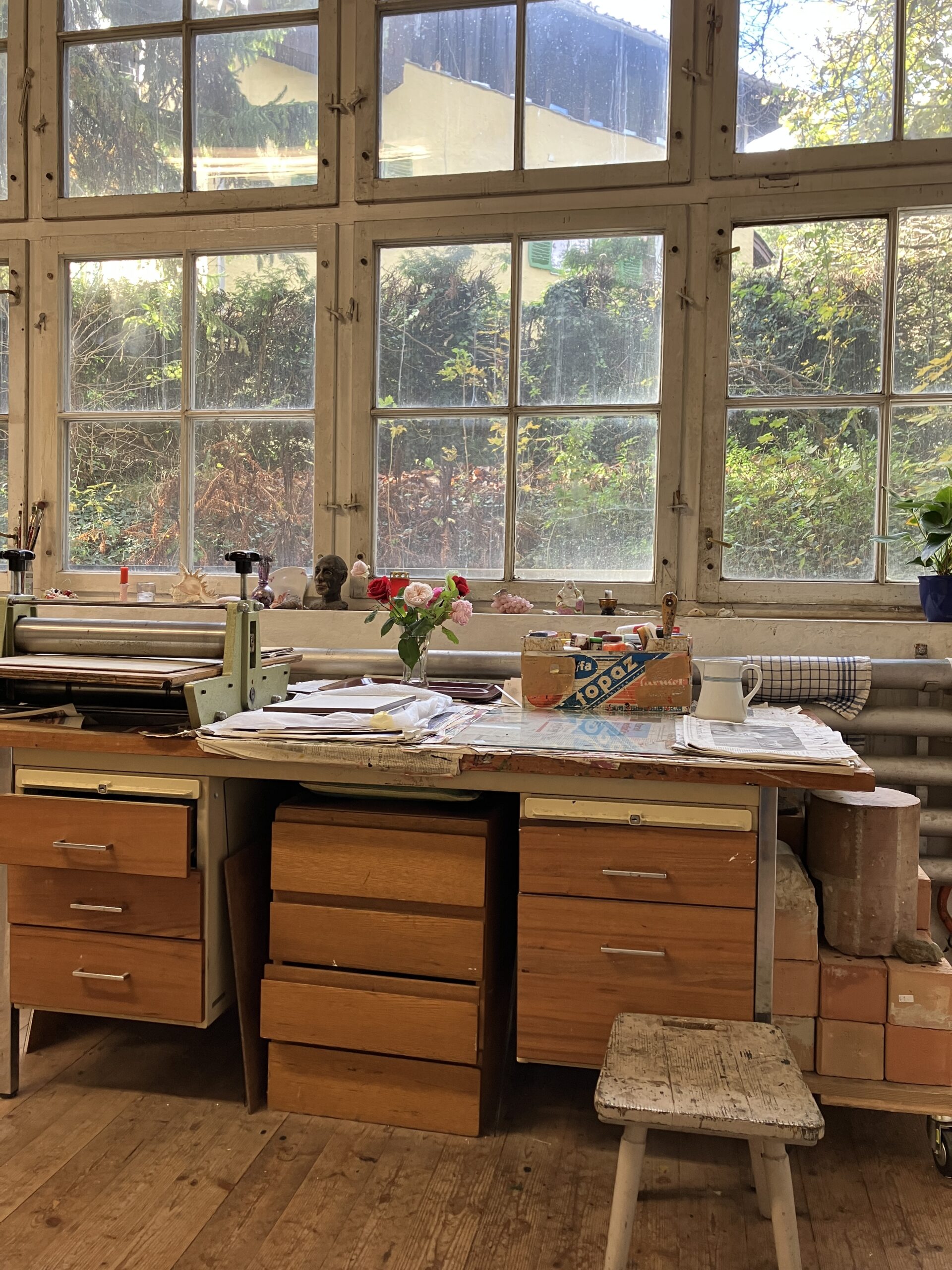
MZ: Ultimately, my work is a bit autobiographical. I don't follow through with a project, it has to happen. The first landscapes, for example, were created when I was with my parents-in-law in Upper Austria and went for long walks. These landscapes are also part of my experience. In the same way, still lifes emerge from the things that accumulate in my studio. At some point I add something to it and think to myself that it could become a drawing or a still life. It grows out of my experience, I do it because it gives me pleasure. Whether it is a good picture or has value for someone else will become clear. For me, the working process itself is an important, intensive time that grounds and sustains me.
The flower paintings are a good example of this: it's not just about painting the flowers, but finding them, arranging them, looking at them and living with them ... I often went flower picking with my grandfather as a child. We'd say: „Now we're going to make a bouquet for grandma or mum“, and he'd show me how to arrange flowers. You shouldn't emphasise it too much because it sounds too sentimental, but I want to conjure up this lost childhood feeling, these beautiful experiences in the countryside, for myself and for others.
So the pictures are not created out of strategic considerations or because I think that's what's missing on the art market. It's nice when a picture succeeds, but it's not the main thing for me.
KiS: „Precision combined with fleetingness. Show everything, reveal nothing. For me, drawing means getting behind the mirror.“ This quote of yours has awakened the association in me that you have to be able to see very well, to perceive very well. How do you learn to see?
MZ: By simply looking at an incredible amount. I started going to museums and exhibitions regularly when I was twelve or thirteen, and I started painting very early on. The one leads to the other: the practical activity, but also the seeing.
You can only judge a picture by comparing it with other pictures. As a painter, draughtsman and photographer, I ultimately compare myself and my work with all the pictures I have created so far. Botho Strauß once said: „You write under the supervision of everything you have ever written.“ When I do something, the past looks over my shoulder. And this art history in the background inspires and inhibits me at the same time.
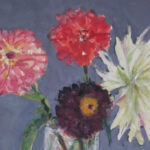
In 2020, I found myself in a crisis due to illness. You think: „What else can I do now?“ And then there were three flowers on the table and I thought: „If I close my eyes and think there's one more picture I could do, then maybe it's this flower picture.“ There's something very existential about that. I put aside the question of whether it was important for art history. But for me it was so necessary or so fulfilling to wipe everything away, to wipe the slate clean, to make this flower painting and see what would come of it.
KiS: I also know this aspect from music: when everything has been composed, from white noise in which all the notes sound simultaneously to John Cage's „4′3333″, in which not a single note is struck, certain end points have been reached. After that, you can do anything again, and then you can write a melody again.
MZ: That's also a bit of my story, because at the end of my studies my work became more and more reduced. By the time I was 27 or 28, I had arrived at colour field painting, i.e. very abstract and strict, and had my first exhibition at Galerie Krinzinger. But I also saw that as a dead end. At that time I was always on holiday in Upper Austria and, as I said, I painted landscapes there. At first I thought it had nothing to do with art, but then I had twenty or thirty pictures together and exhibited „representational“ landscapes for the first time in Salzburg. That's how it turned out that the figurative is also a path for me and that new paths open up for me in painting.
KiS: Flower pictures - such as the „Geraniums“ from 1987 - were already around back then ...
MZ: Yes, but very, very rarely.
KiS: In 2020, on the other hand, you stuck to the topic ...
MZ: For a while, I actually only took flower pictures. I looked for flowers, walked around and sometimes bought some in the market hall. In the beginning it was winter. That was important because they lasted relatively long on the veranda and I had more time to paint them. Over time, I became more and more experienced.
KiS: Why are drawing and watercolour the means of choice for these pictures?
MZ: I can actually only create this very light, weightless, floating, sketchy effect with these watercolours in this form. These are not watercolours - for me they are occupied as something virtuoso - but gouache paints, in other words nothing other than school-cover paints.
KiS: Rafael Jablonka has also selected still lifes for the exhibition at KiS - Kunst in Seefeld. There are recurring elements such as cherries and others that appear rarely or only once, like a playing card. How do you put together such arrangements?
MZ: It's always a mixture of something arranged and something found by chance. For example, I found the playing card on the floor and took it home with me. It then stood here by the vase for a while. It always takes a while before I start making the still life. I always have the feeling that when the time comes, the things create a little narrative. First I make a small sketch, then a drawing and then comes the watercolour sheet. Very rarely does it continue in the direction of an oil painting.
In photography as well as in drawing and painting, I try to create immateriality in different ways. In drawing, I can make something practically float by making it very delicate; with colour, it has to be very loosely covered. It has to breathe. I could theoretically add colour over backgrounds like the flower pictures, but it has to have something floating about it. If that doesn't work, then I have to start all over again. There's something meticulous about it, but in the end it shouldn't look like a lot of work.
KiS: This floating, indeterminate quality is also linked to a central theme of your art: the simultaneity of proximity and distance. What is this about?
MZ: You could call it eroticism in the broadest sense. Eroticism is the short circuit of a simultaneous closeness and distance. For me, it's about the erotic gaze - not in the sexual sense, but there has to be a distance to something and at the same time it has to grow together with me. It's about a longing for something that you might want to attain, and at the same time you have to be filled with it.
KiS: How does this simultaneity of fulfilment and emptiness become visible in your pictures?
MZ: That simply has to prove itself in a picture when it hangs on the wall. It's important that you exhibit. That already started during my studies: Once a week, you laid your work out on the floor. Then the professor and your fellow students came and looked at everything. After that, you knew if you were on the wrong track or your work was confirmed. After graduation, the exhibition work took over. This going out in public is a test.
KiS: One that you like to expose yourself to?
MZ: Yes and no (laughs). I'm more the kind of person you have to push a bit. But when I do it, it's always good.